DRAM: Across-the-Board Price Hikes, DDR4 Shows Significant Growth
The DRAM market, particularly DDR4, is experiencing exceptionally strong growth.
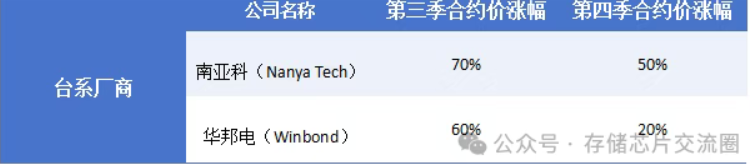
· Price Increases: Market sources indicate that Taiwan-based Nanya Technology's contract prices surged 70% quarter-over-quarter in Q3, with a further 50% increase anticipated for Q4. Winbond's Q3 quotes also rose 60% quarter-over-quarter, with expectations of another 20% increase in Q4. Compared to the low point in Q2 this year, Winbond's cumulative increase has approached 90%.
· Reasons for Price Increases: This is primarily due to major international manufacturers like Samsung, SK Hynix, and Micron gradually halting production or significantly reducing capacity for older-generation DDR4 chips, redirecting resources toward more profitable DDR5 and HBM (High Bandwidth Memory). However, many sectors—including budget smartphones, televisions, routers, industrial control systems, and automotive applications—continue to exhibit stable and substantial demand for DDR4. Supply is rapidly decreasing while demand is only gradually declining, causing the supply-demand gap to widen continuously. By the fourth quarter of 2026, global DDR4 production capacity is projected to be only 25%-33% of its first-quarter 2025 level.
· Taiwanese manufacturers expand production against the trend: Facing the withdrawal of major international players, Taiwanese companies like Nanya Technology and Winbond Electronics have chosen to expand production against the trend. This move aims to fill the market void and is expected to boost their market share and profitability.
NAND: Price Hikes Begin, Original Manufacturers Seek Stronger Profits
The curtain has risen on price increases in the NAND flash memory market.
· SanDisk Leads the Way: On September 4, 2025, SanDisk announced price increases of over 10% for all channel and consumer products. This adjustment primarily reflects robust demand for flash products in AI applications, data centers, and mobile sectors, supporting ongoing innovation investments. Industry consensus views this as initiating a new NAND price hike cycle, with other manufacturers expected to follow suit.
· OEM Profit Pressure Drives Action: Persistent NAND price declines previously squeezed OEM profitability, even causing losses. For instance, SanDisk reported an operating loss in Q1 2025 due to falling NAND volumes and prices. While it returned to profitability in Q2, net profits remained significantly below the same period last year. Boosting NAND product margins has become urgent for OEMs.
· Domestic manufacturers follow suit: Industry sources indicate Yangtze Memory Technologies Co. (YMTC) also plans to raise prices in the fourth quarter. This signals that domestic storage manufacturers are gaining market influence as their technologies mature—such as the mass production of 232-layer NAND.
Following SanDisk's 10% price hike, Micron is set to raise prices by 20%-30% and suspend quotations.
After SanDisk announced last week that it would increase storage product prices by over 10%, Micron today notified its channels that storage product prices will soon rise by 20%-30%.
Effective immediately, all quotations for DDR4, DDR5, LPDDR4, LPDDR5, and other memory products are suspended. Contract pricing for all customers is canceled, with quotations halted for approximately one week.
This adjustment extends beyond consumer and industrial memory products, with automotive electronics expected to see a 70% price increase.
According to supply chain sources, Micron executives observed significant supply shortages in customer forecast demand, prompting the emergency suspension of all product quotations. Subsequent pricing adjustments will be implemented.
Current Market Price Overview
Recent data indicates that while overall memory chip prices have stabilized, significant divergence persists:
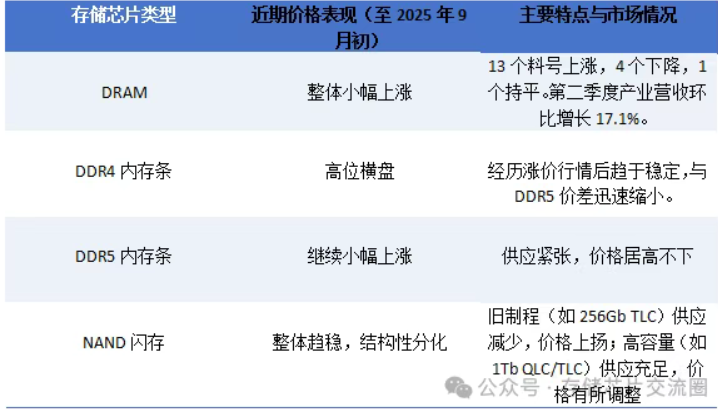
· DRAM Memory: Prices remain robust. During the same period, spot prices for 18 DRAM categories rose by an average of 0.68%, with 13 part numbers showing increases. TrendForce data shows DRAM industry revenue grew 17.1% quarter-over-quarter in Q2 2025. Notably, the price gap between DDR4 and DDR5 memory modules is rapidly narrowing, with some comparable-capacity products now within a 20% margin.
· NAND Flash: Spot prices have stabilized overall recently, though internal divergence persists. According to a report by Yongxing Securities, the average price fluctuation for 22 NAND flash chip categories during the week of early September 2025 was -0.03%. As original manufacturers accelerate capacity shifts to new processes, supply of older-process 256Gb TLC NAND has decreased, driving price increases. Conversely, high-capacity products like 1Tb QLC/TLC Flash Wafers saw downward price adjustments due to relatively ample supply.
Below is a comparison of recent price trends for major storage chip types:
Future Outlook: Uptrend to Continue in Q4 2025
Market analysis widely anticipates a comprehensive price increase across the memory chip sector in the fourth quarter of 2025.
· Price Increase Forecast: Overall, DRAM (particularly DDR4) is projected to see substantial gains, with some forecasts indicating contract prices may rise 20% to 50% quarter-over-quarter. For NAND flash, enterprise-grade storage prices are expected to achieve single-digit growth, while mobile embedded storage (eMMC/UFS) prices will also see modest increases.
· Key Drivers:
· AI-Driven Demand: The construction of AI servers and data centers continues to fuel explosive demand for high-performance storage solutions like HBM and enterprise-grade SSDs. Micron estimates that each AI server requires 8 times the DRAM and 3 times the NAND of a standard server. Major domestic internet giants (such as Alibaba, Baidu, and Tencent) are also significantly increasing capital expenditures on AI infrastructure, driving storage demand.
· Traditional Peak Season & New Product Launches: The electronics industry's traditional peak season has arrived. Smartphone manufacturers are launching new models in succession (e.g., the iPhone 17 series completely eliminating the 128GB version, starting at 256GB), driving device replacement demand and storage capacity upgrades.
· Persistent Supply Tightness: Original manufacturers maintain their capacity control strategies. DRAM production continues shifting toward HBM and DDR5, while NAND manufacturers have strong profit-seeking motives and high willingness to raise prices.
Key Focus: HBM and Domestic Storage
· HBM (High Bandwidth Memory): As a core component of AI accelerators, HBM demand remains robust with rapid technological iteration (e.g., SK Hynix has begun developing HBM4), indicating broad market prospects. SK Hynix projects the customized HBM market will grow to tens of billions of dollars by 2030.
· Development of Domestic Storage: Following technological breakthroughs, domestic manufacturers like Yangtze Memory Technologies Co., Ltd. (YMTC) are actively engaging in global market competition and price adjustments. Micron's decision to halt development of certain mobile NAND products also presents growth opportunities for other NAND manufacturers, including domestic players.
⚠️ Risk Warning
Despite the booming memory chip market, several uncertainties persist:
· Downstream End-User Demand: If the global economic recovery falls short of expectations or the adoption pace of AI applications slows, actual demand may prove weaker than current market projections.
· Geopolitical and Trade Frictions: External factors such as Sino-US trade tensions may disrupt the global semiconductor supply chain.
· Technology Iteration and Capacity Adjustments: Original manufacturers' rapid shifts in capacity strategies and technology roadmaps require close monitoring.
Summary
The current memory chip market, particularly DRAM (represented by DDR4), is undergoing a significant price increase cycle driven primarily by supply contraction (capacity shifts) and sustained stable demand. NAND flash memory has also initiated price hikes amid strong profitability demands from original manufacturers. The core driver is the high-performance storage demand spurred by AI, with HBM poised for promising growth as a key component. Memory chip prices are expected to maintain a broad upward trend throughout the fourth quarter.
We hope this information helps you better navigate the pricing dynamics of the memory chip market.



Copyright © 2025 Hefei ARKO Electronic Technology Co., Ltd. All Rights Reserved.
 扫一扫咨询微信客服